
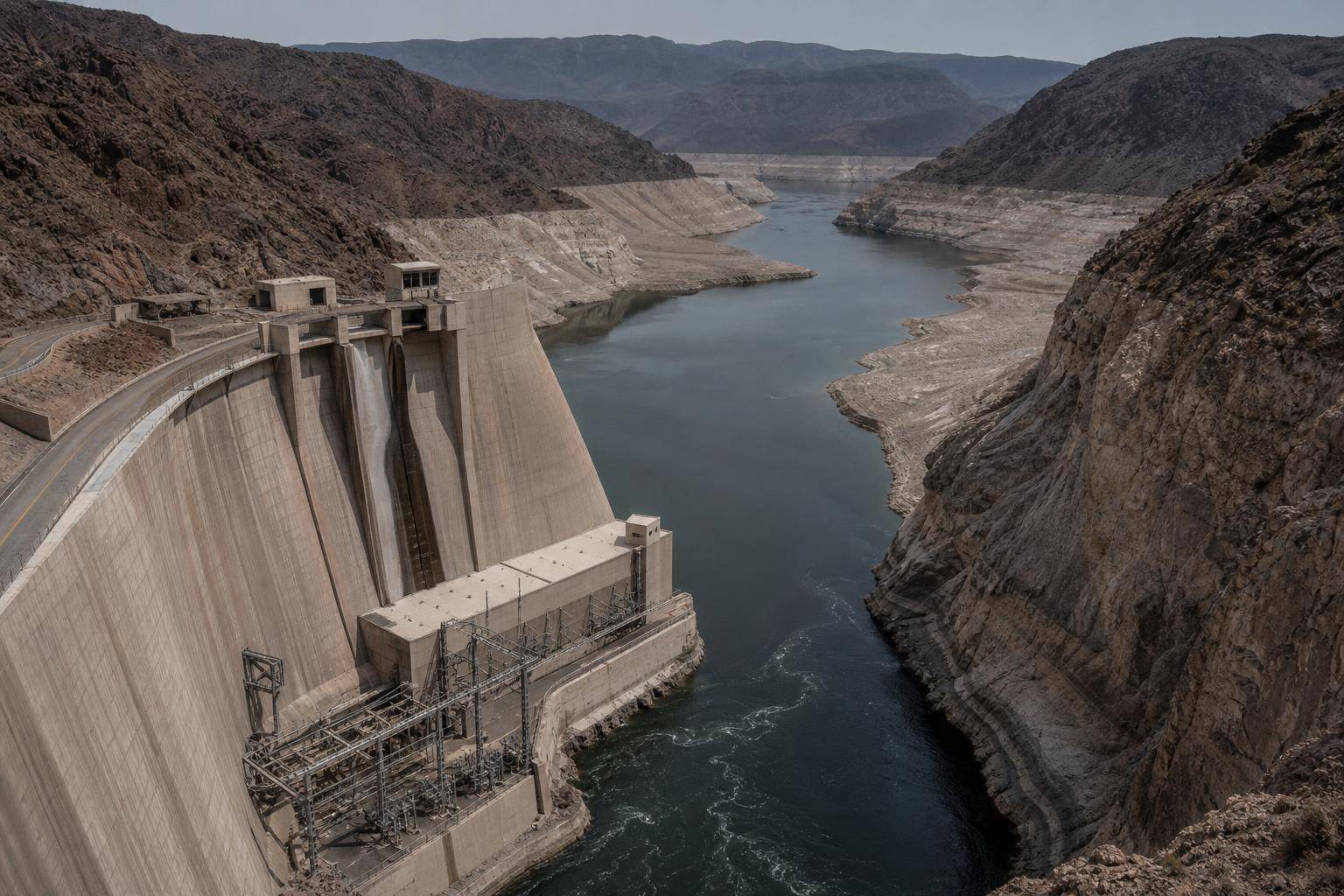
Record low generation this summer
Hydropower generation in the Southwestern electricity supply region fell to record lows this summer, according to the U.S. Energy Information Administration.
According to the EIA's Form EIA-923 survey data, hydropower generation from April through August 2026 was 19% lower than during the same period last year and 28% lower than the 10-year average. According to the EIA, the Southwestern electricity supply region includes Arizona, New Mexico, and small parts of Nevada and California.
Reservoir elevations and operations
Water elevations at Lake Powell and Lake Mead, formed by Glen Canyon Dam and Hoover Dam respectively, hit record lows, the EIA reports.
According to the EIA, Lake Powell should have an elevation of at least 3,490 feet (the minimum power pool), and at the end of September the lake reached 3,518 feet, less than 1% above minimum power pool. According to the EIA, Lake Mead requires an elevation of at least 950 feet, and by the end of September Lake Mead reached 1,038 feet, 9% higher than minimum power pool.
Water management steps taken
To mitigate the risk of Lake Powell falling below the minimum power pool, the EIA reports water was released from Flaming Gorge in the Upper Colorado River Basin and water releases from Lake Powell were reduced to maintain an elevation of at least 3,510 feet given the most probable water inflows, according to the EIA.
According to the EIA, the U.S. Bureau of Reclamation manages most dams across the Colorado River Basin and seven states—Arizona, California, Colorado, Nevada, New Mexico, Utah, and Wyoming—depend on the river for hydropower generation and other water supply needs.
Outlook from the Short-Term Energy Outlook
The EIA's November Short-Term Energy Outlook (STEO) projects hydropower generation in the Southwest will total 6.13 billion kilowatthours (BkWh) in 2026, the EIA says.
According to the EIA's STEO, that 2026 total is 9% lower than last year and 24% lower than the 10-year average, and the EIA expects hydropower generation in the Southwest to total 6.1 BkWh in 2027, 0.5% lower than 2026. According to the EIA, the STEO estimates hydropower will account for about 4% of the region's generation mix in 2026, down from a peak of 8% in 2011, and the EIA says this year’s El Niño could bring more precipitation than normal and improve the hydropower generation forecast, while noting one good water year likely won't eliminate the effects of multiple years of water scarcity.
What to watch
According to the EIA, the Department of the Interior decided to reduce the collective water consumption of California, Arizona, and Nevada by 1.25 million acre-feet each year over the next two years.
According to the EIA, the November Short-Term Energy Outlook contains the agency's generation projections for 2026 and 2027 and reflects current expectations for how hydropower generation in the Southwest may perform.